

Germany’s AI Founder Pipeline: Which Companies and Schools Produce the Most Founders
We traced German AI founders' professional and academic backgrounds to identify the best talent pipelines.
We’re back with a new article for our AI founders’ series. After breaking down France, we’re now heading to Germany.
But before we get to the founders, let’s look at the market itself. Germany ranks third in Europe in The Observer’s global AI ranking. From automotive automation to fintech intelligence systems and industrial IoT platforms, AI is becoming deeply embedded in enterprise workflows nationwide. As adoption grows, demand for AI startups in Germany is also rising. Over the last few years, the country has produced some of Europe’s most talked-about AI startups, including Black Forest Labs, Parloa, and n8n.
To understand where these founders come from, we reviewed 534 German AI companies...
All are founded and/or headquartered in Germany.
Stages range from Seed to Late Series and Acquisition.
All building core-AI products.
In total, we identified 1321 founders. Then, we traced their professional and academic backgrounds to identify the best talent pipelines for German AI founders.
Which companies are the best training grounds for German AI founders?
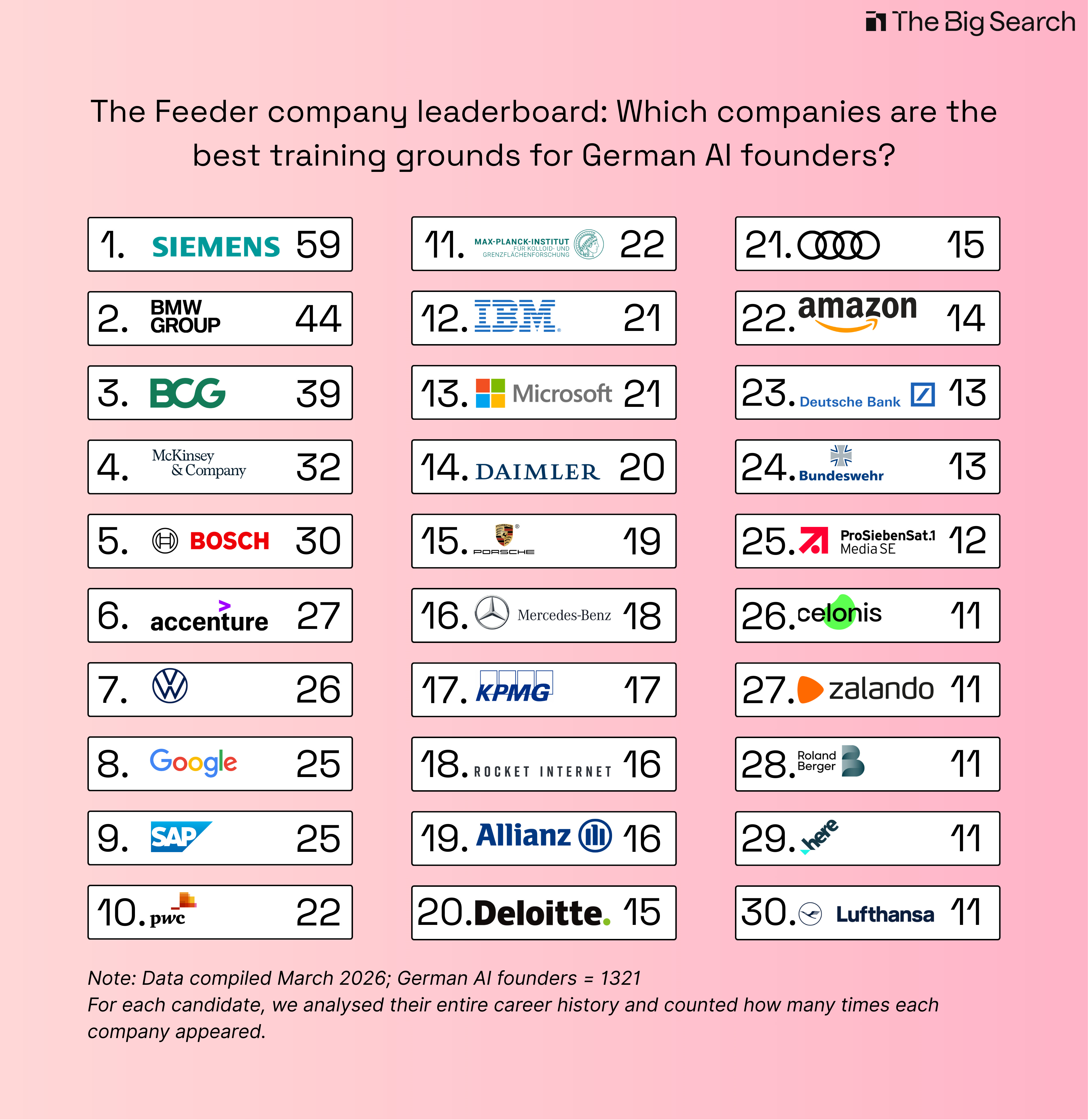
If you’re looking for the company that produces the most German AI founders, Siemens is number one with 59 alumni. Over the last couple of years, the company has positioned itself as a global leader in industrial AI. It notably runs a dedicated AI Lab in Munich with ~1,400 AI experts to scale its AI offerings across electronic design automation, simulation, adaptive manufacturing, supply chains, and factory capabilities
Similarly, in the top 30, you have 6 automotive companies: BMW, Volkswagen, Daimler, Porsche, Mercedes-Benz, and Audi. Germany’s strength in the automotive sector isn’t new. However, the industry is currently advancing digitalisation and AI in production and vehicles. From automating factories to building computer vision and edge computing for autonomous driving, these companies provide a top learning ground for future AI founders.
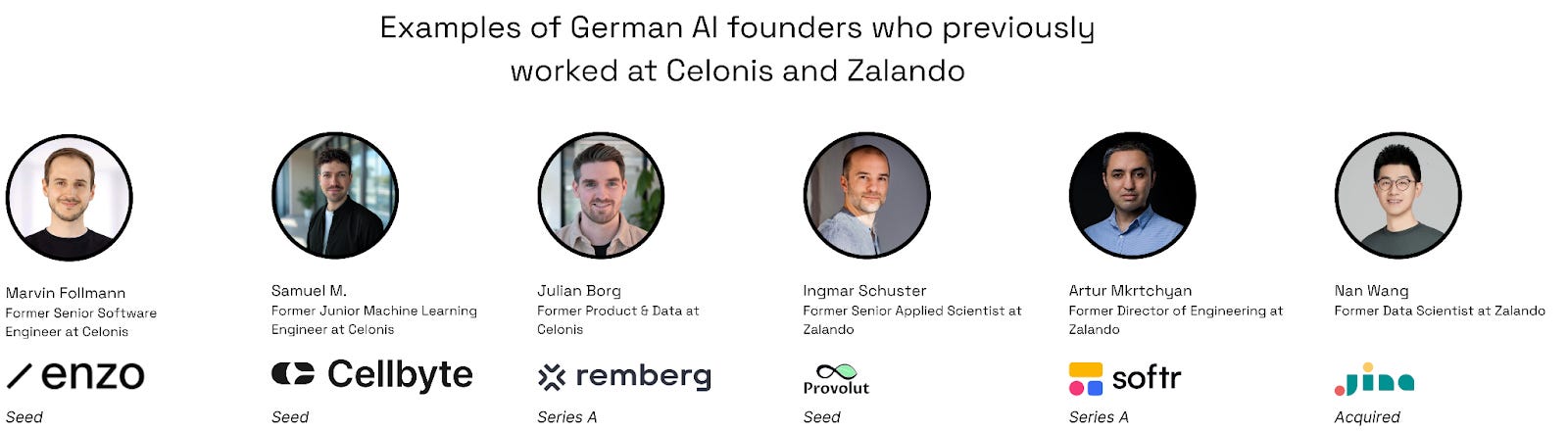
In our previous piece on French AI founders, we found that the top 30 included several research centres and no fast-scaling younger tech companies. Within the German leaderboard, only the Max Planck Institute appears, while Celonis and Zalando rank in the top 30. We also found that many of their alumni held roles in Data Science, AI, ML, or engineering.

And when you adjust for company size, per 10k FTEs, Celonis produces 11.2x more German AI founders than Siemens, and Zalando produces 3.5x more!
Which universities are the best schools for German AI founders?
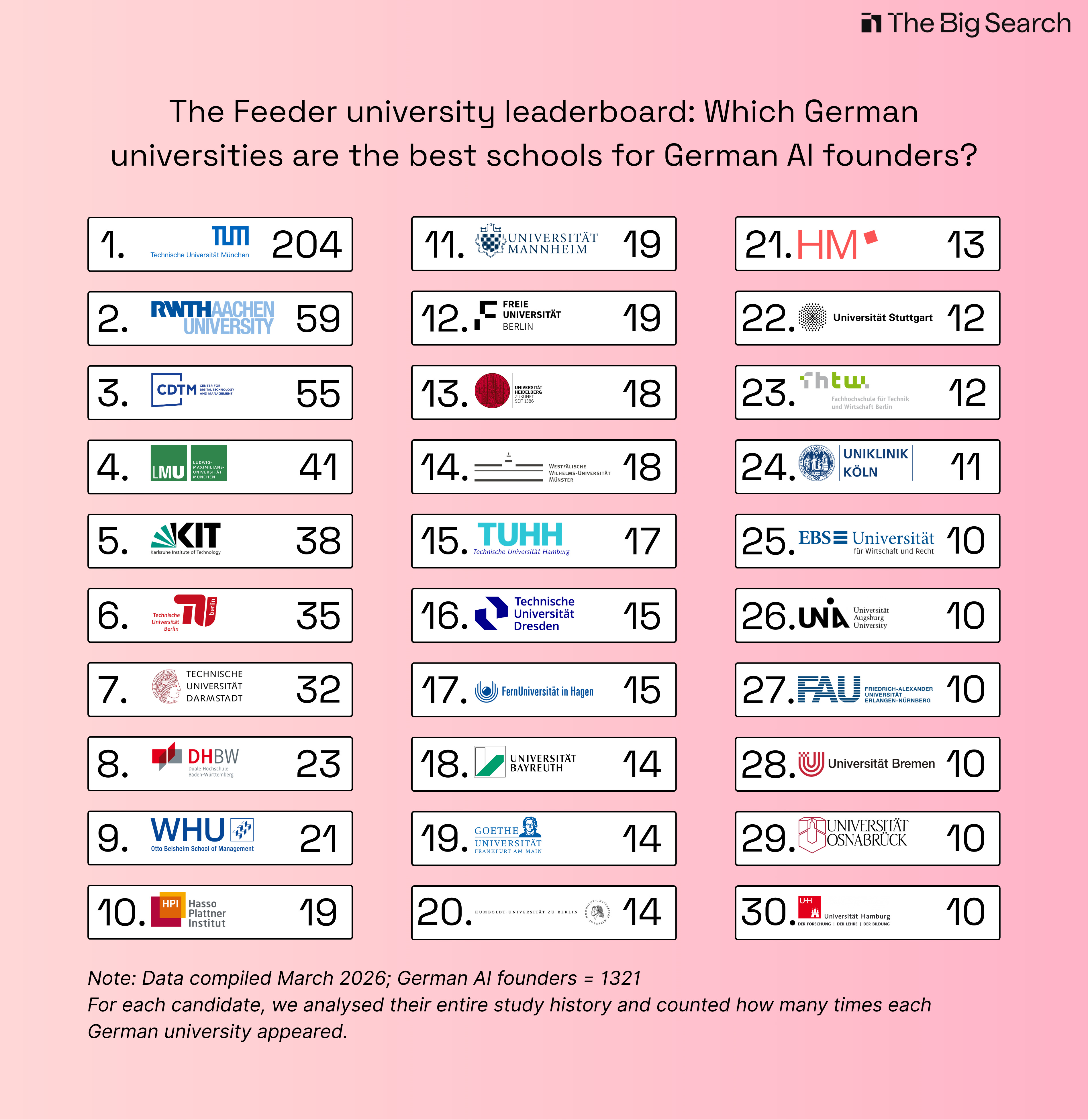
For universities, we only looked at German institutions. We excluded international schools such as Stanford, Berkeley, Oxford, Cambridge, and ETH Zurich, even though they appeared frequently.
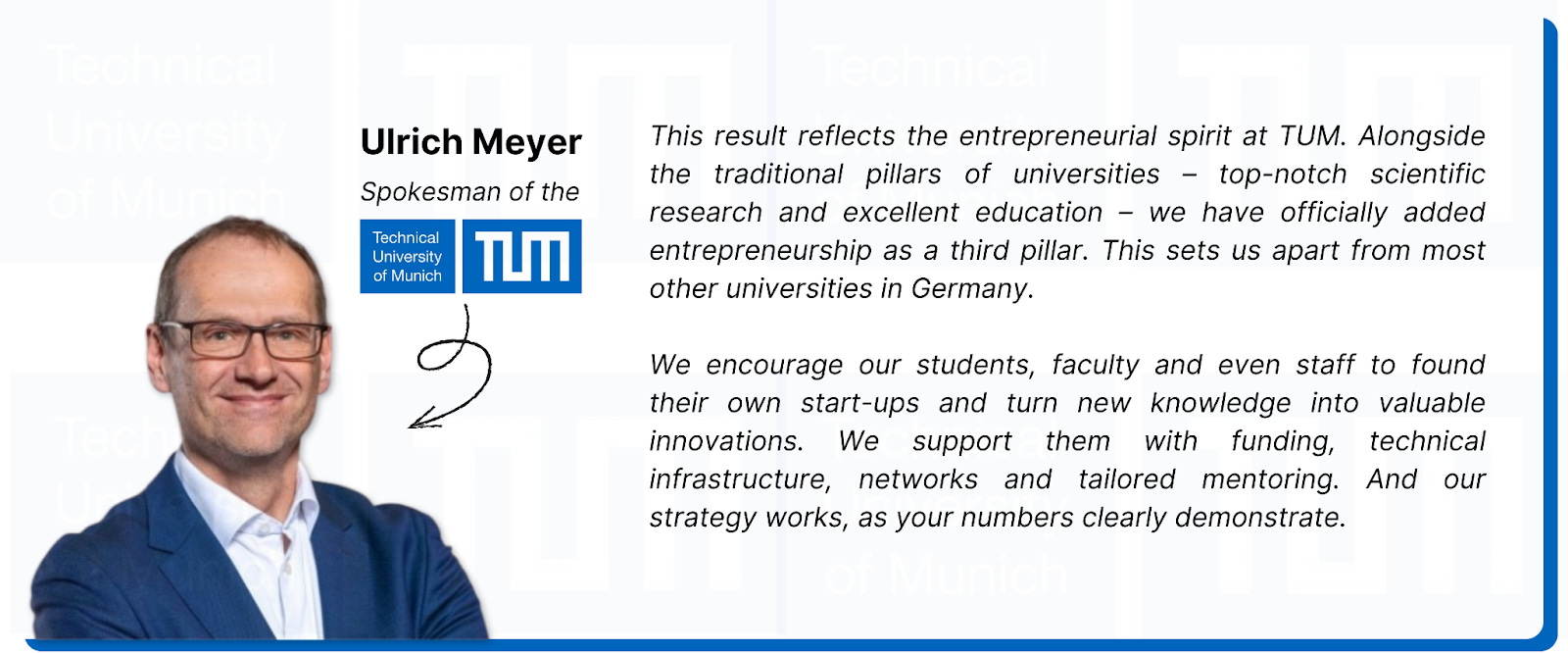
If you look at the top, the Technical University of Munich dominates, with 204 alumni. That means 15% of all German AI founders studied there! TUM ranks #1 in Germany and #22 globally in the 2026 QS World University Rankings. Its affiliated innovation centre, UnternehmerTUM, is also one of the leading startup hubs in Europe. It gives founders a seamless pipeline from academic research to venture capital. Many founders have spun out of TUM through this ecosystem.
Munich and Berlin dominate overall, with four universities each in the top 30. Munich alone places three universities in the top 4: the Technical University of Munich, the Centre for Digital Technology and Management, and the Ludwig Maximilian University of Munich. This concentration reflects where most AI activity happens: Berlin accounts for 30.3% of the German AI market, and Munich for 25.2%.
But the leaderboard points to other strong hubs: Aachen, Darmstadt, Heidelberg, Karlsruhe, Hamburg, Cologne, or Frankfurt. Germany doesn’t depend on a single AI capital, like Paris or London. Instead, it also relies on a network of regional hubs, closely tied to local academic institutions.
It’s also worth noting that many of these universities are part of the High Tech Agenda Germany, which focuses on strengthening national AI sovereignty and technological independence.
For investors, this mapping serves as a particularly valuable interpretative tool. It highlights the historical talent pipelines where future German AI founders emerge and allows for the anticipation of upcoming hubs of value creation. The current dominance of industrial, automotive, and consulting sectors reflects Germany’s long-standing strength in these fields.
However, most AI-native companies are showing unprecedented growth, and it’s likely to continue in the coming years. As more capital flows into German tech and more top German AI scale-ups break through, other companies could, in turn, train the founders of tomorrow.
Want to see how we can support your search? Visit our website to explore our services and learn what we can do for you.