

The Big Search x Curiosity. French AI Mafia: Which Companies and Schools Produce the Most AI Founders?
We traced their professional and academic backgrounds to find out which places are the best training grounds for French AI founders.
France is one of the world’s strongest AI hubs. Thanks to proactive government initiatives, a deep talent pool, ample European and US capital, and a wave of top AI companies, the French AI ecosystem is steadily climbing the global AI ranking. It went from the 13th place in the Global AI Index in 2023 to the 6th position in 2025, which puts it right behind the UK.
You probably know some of the names driving this growth. Mistral AI, H Company, Poolside, or Hugging Face. Each one has raised 9-digit rounds and contributed to France’s AI expansion. However, the ecosystem’s success goes well beyond these big names. It’s also benefiting a lot from smaller startups, private tech AI labs, and public research hubs. Put it all together, and you get a large and diverse sector that keeps producing top AI talent.
And that’s what we wanted to focus on.
We reviewed 403 French AI DeepTech companies...
All of them are founded or headquartered in France.
Seed stage to Late Series and Acquisition.
All building core-AI products across AI, ML, Deep Learning and Natural Language Processing.
In total, we identified 834 founders. Then, we traced their professional and academic backgrounds to find out which places are the best training grounds for French AI founders.
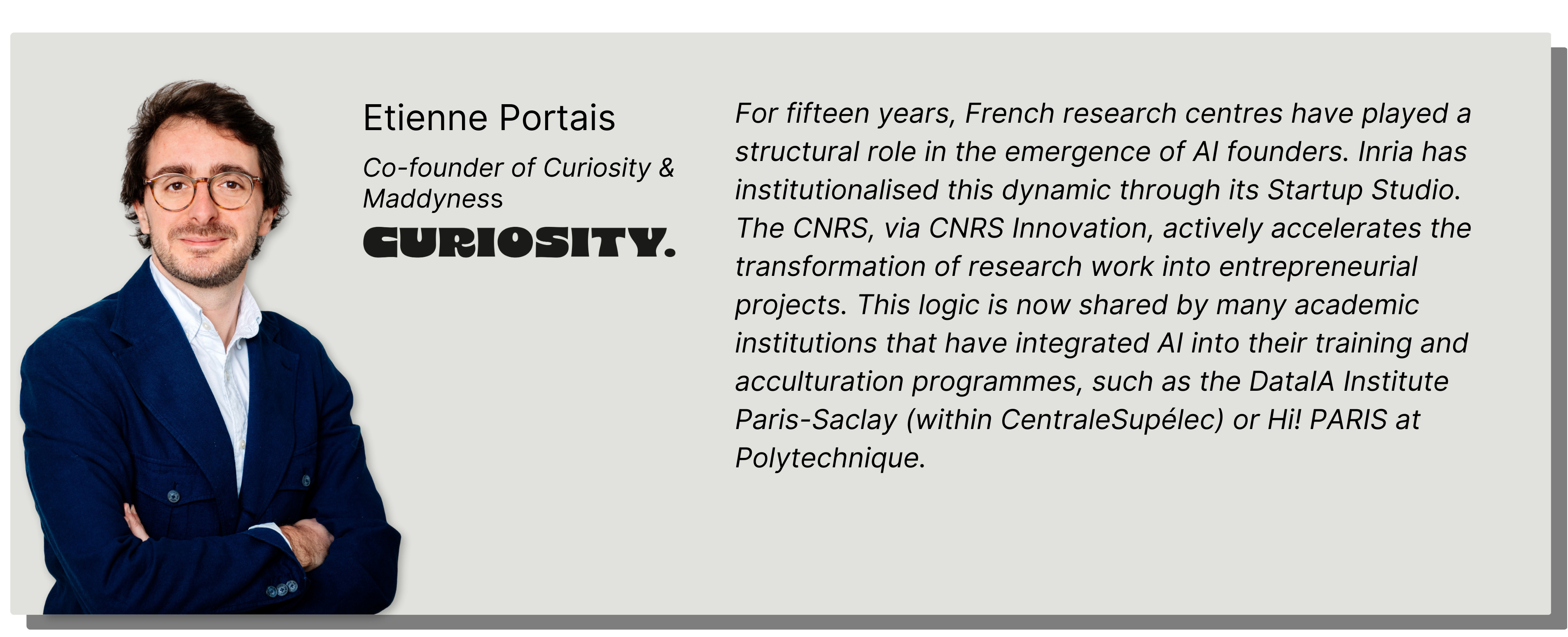
We also partnered with Etienne Portais, founder of Curiosity1 and Madynesss, whose expertise and understanding of the French market helped us better interpret the data.
This report was compiled by the Consumer Practice at The Big Search. If you're interested in leadership and talent trends, looking to hire a leader, or simply want to discuss the findings, feel free to reach out: sahar @thebigsearch.com or Sahar Powell (PhD).
Which companies are the best training grounds for French AI founders?
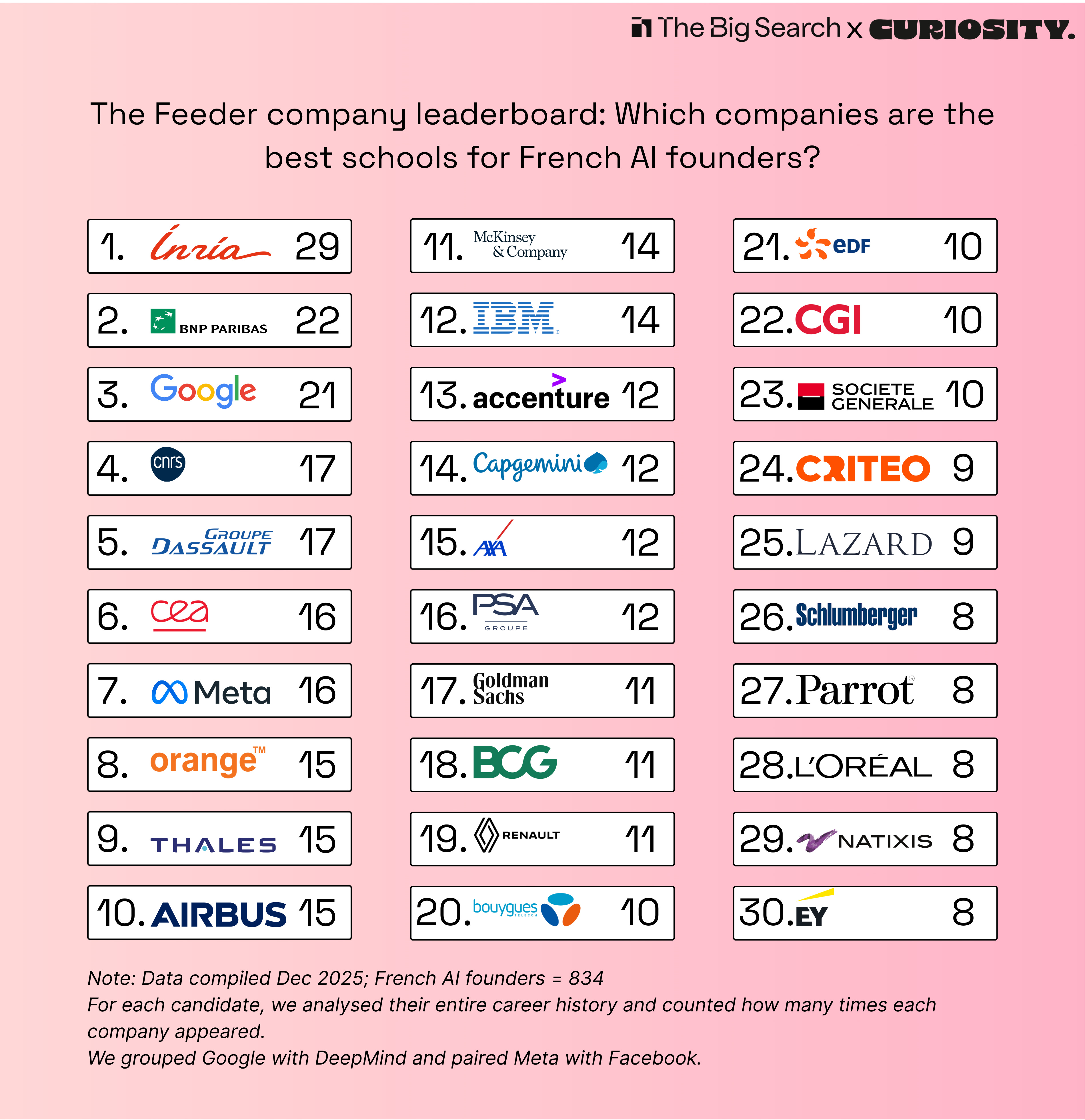
If you’re looking for the organisation that produces the most French AI founders, Inria sits comfortably at the top with 29 of them. The institute is a go-to destination for PhD students and young researchers in France, boasting a long-standing track record of supporting innovative startups.
In the top 10, you also find the other research centres, CNRS and CEA. Both run large AI research programmes, often in partnership with Inria, as part of the national AI strategy.
You can also see that Google, Meta, and IBM appear in the top 10. France is the main European base for AI research for several global actors, including Google, DeepMind, Meta, IBM and OpenAI. The Mistral founding story is the perfect example of this big tech-to-French startup pipeline. Mistral’s three founders all worked as researchers at DeepMind (Google) and Facebook AI (Meta) before launching the company in 2023.
Beyond that, the leaderboard is a mix of established, mature French organisations: banks, consulting firms, defence, aerospace, automotive, and critical systems. A few international consulting companies also show up.
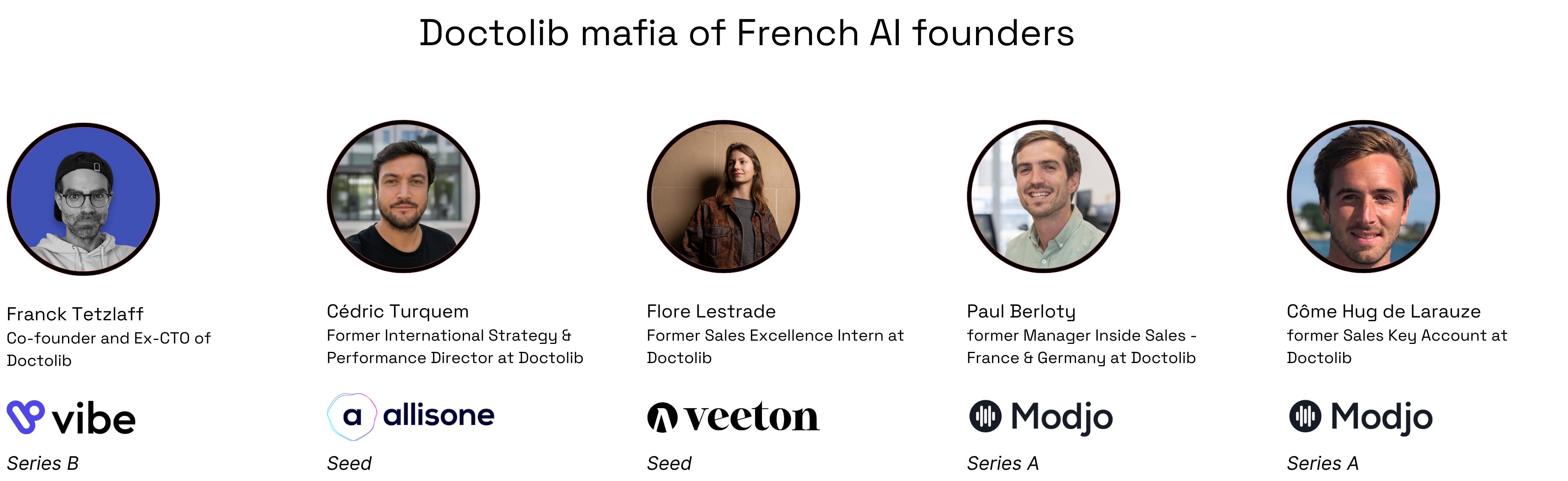
What about fast-scaling younger companies? The first one on the list is Doctolib in 35th place with five alumni...
Which companies produce the most French AI founders per 10K FTEs?
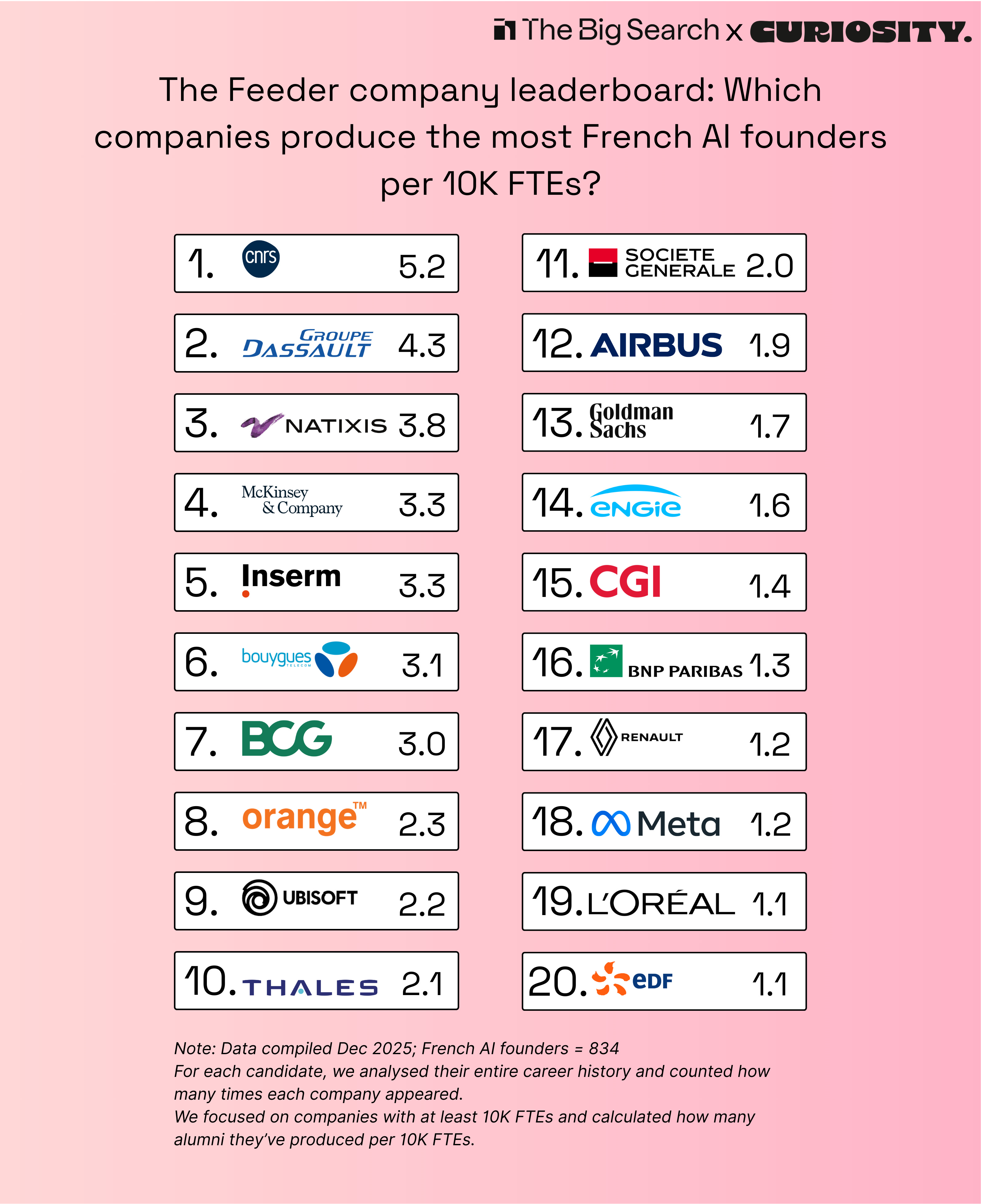
Next, we looked beyond volume and measured the relative efficiency of feeder companies. We focused on organisations with at least 10K FTEs and 5 alumni and calculated how many French AI founders they’ve produced per 10K FTEs.
Once again, a public institute leads the ranking. CNRS stands out as the most efficient founder pipeline. Inserm also appears in the top 5, which shows that health research is becoming a strong AI feeder. Among major French AI unicorns, Owkin and Dental Monitoring both operate in the Healthtech and Biotech space.
The defence & aerospace sector also has a very high founder density, and the pipeline looks strong. Of course, Dassault, Thales, and Airbus operate across both defence and civilian sectors, but together they produce founders at a much higher rate than some civilian groups. Many new French AI startups are actually tackling autonomy, sensing, navigation, cyber or dual-use. A good example is Preligens, acquired by Safran in 2024 for €220m and co-founded by Renaud Allioux, who previously worked at Airbus Aerospace and Defence.

Which universities are the best schools for French AI founders?
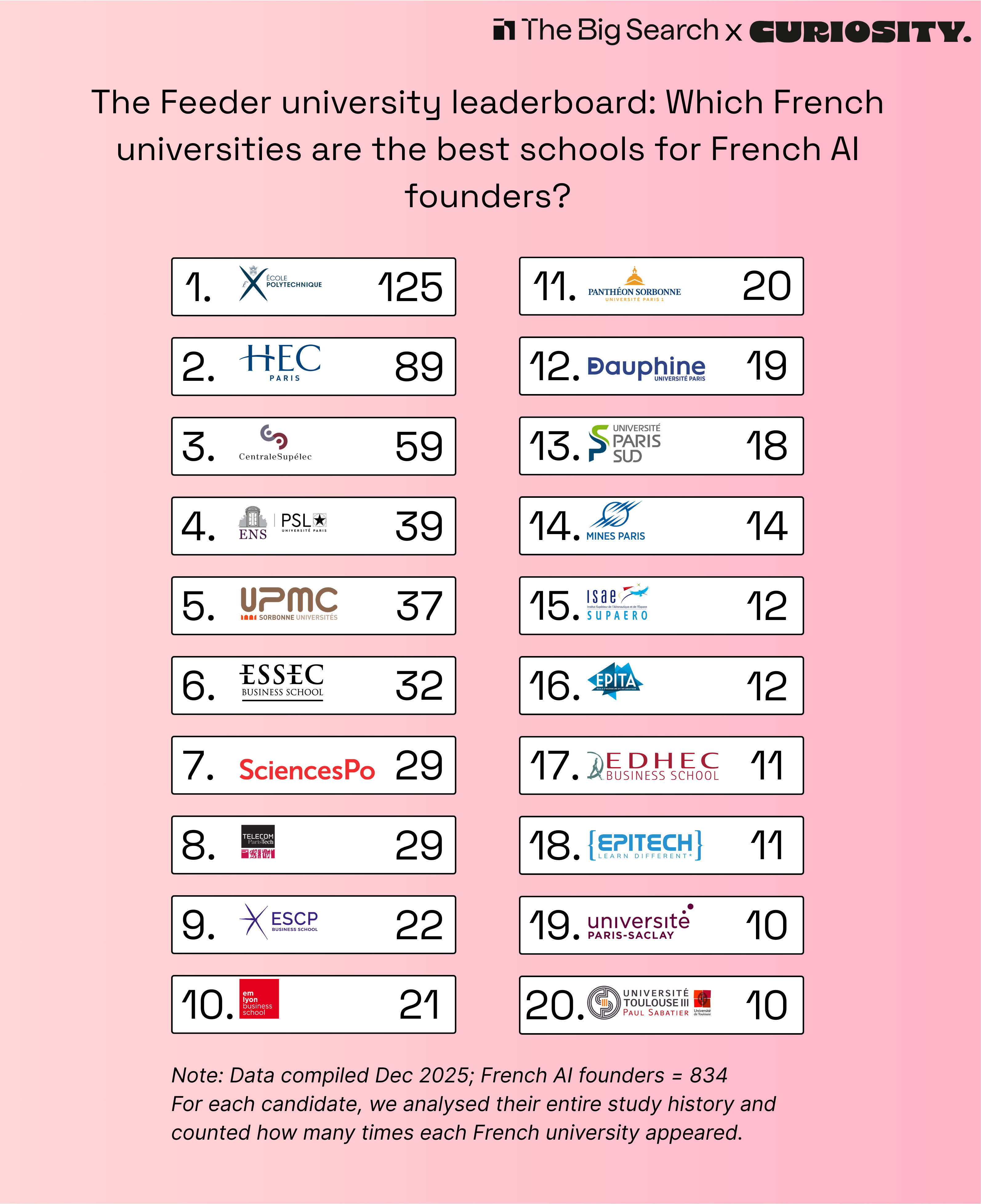
For the first time on The Big Byte, we looked at feeder universities to see which ones serve as the strongest training grounds. We only looked at French schools and left out international ones, such as Stanford, Berkeley, MIT, or Imperial College London, that appeared often as well.
If you look at the top, Polytechnique dominates, with 125 alumni. That means 15% of all French AI founders are polytechnicians! Mistral’s founders, Arthur Mensch and Guillaume Lample, studied there. Hugging Face’s founders, Julien Chaumond and Thomas Wolf, did as well.
Behind Polytechnique, you’ll find HEC, which plays an active role in the French tech ecosystem and runs one of the main startup incubators at Station F, along with an AI Startup Accelerator.
For the rest of the leaderboard, it’s a mix of engineering schools like CentraleSupélec and Télécom Paris, Paris research universities like Pierre and Marie Curie University, and business and political science schools like ESSEC and Sciences Po.
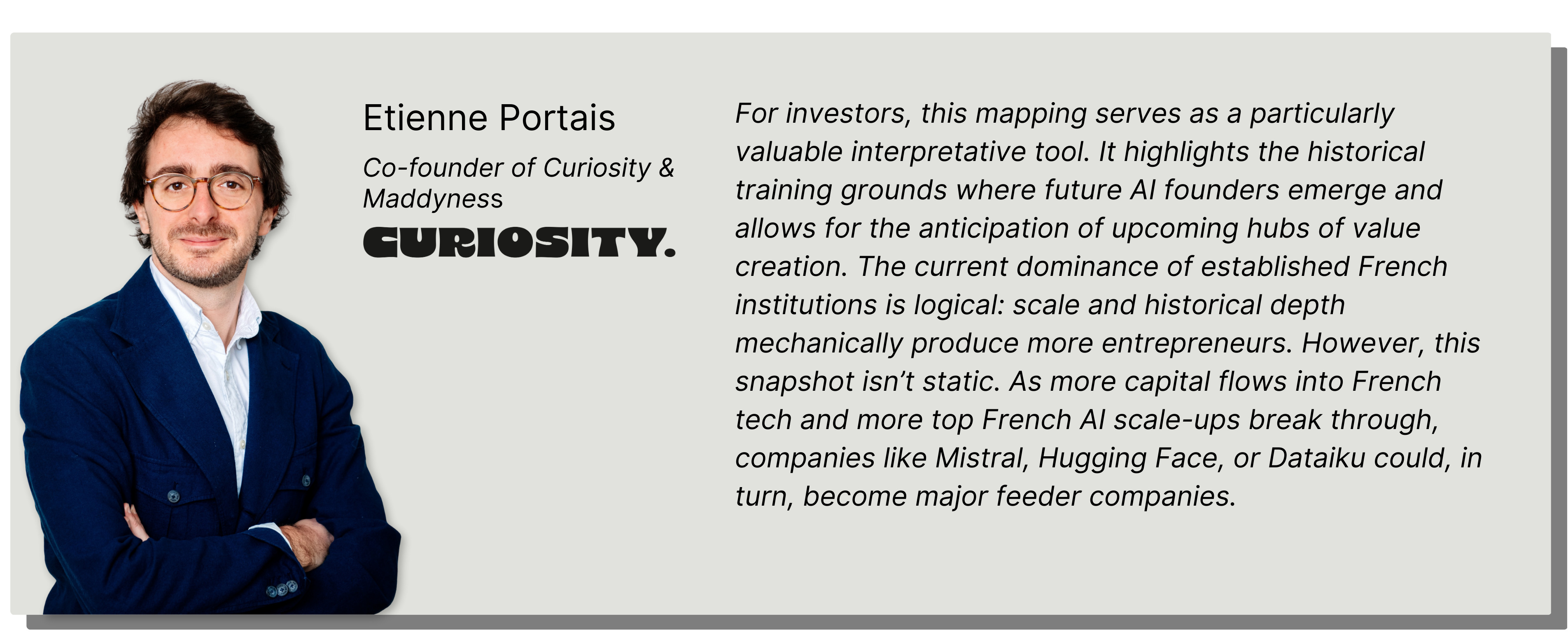
Give it a few years, and people may end up talking about a Mistral mafia shaping the French AI ecosystem in the same way people already talk about the Klarna mafia in fintech.
Want to see how we can support your search? Visit our website to explore our services and learn what we can do for you.
French strategy, communication, and GTM consulting firm