

Company Focus: What RobCo’s Revenue Team Reveals About Scaling a European Novel Robotics Company to the US
We looked at RobCo’s revenue organisation to understand how it’s being built, where its talent comes from, and what it reveals about scaling a European robotics company.
For this piece, we’re heading to Germany and the US to take a closer look at RobCo’s revenue team.
But first, a bit about the company itself.
Founded in 2020 by Roman Hölzl, Paul Maroldt and Constantin Dresel, RobCo builds modular AI-powered industrial robots that automate repetitive tasks in production environments. Their goal is to make advanced robotics accessible for every industrial company.
The robotics company gained momentum in 2024 when it raised $43M at Series B in February 2024. It was a massive success back then, as very few Series B deals were happening in Europe at the time. The round was led by Lightspeed Venture Partners, with Sequoia, Kindred Capital, and Promus Ventures also joining in.
Now, RobCo is on a growth journey and recently announced its US expansion. However, many European DeepTech companies actually struggle at this point because you can’t exactly find people who are technically credible, commercially sharp, and trusted within their target industries on every DeepTech street corner.
So, we looked at RobCo’s revenue organisation to understand how it’s being built, where its talent comes from, and what it reveals about scaling a European robotics company.
In total, we identified 55 current individuals from junior to C-level. Interestingly, the revenue team makes up about a third of RobCo’s total headcount, something quite rare among DeepTech companies at this stage.
Now, let’s dive into their backgrounds.
RobCo’s current revenue team leans on software expertise
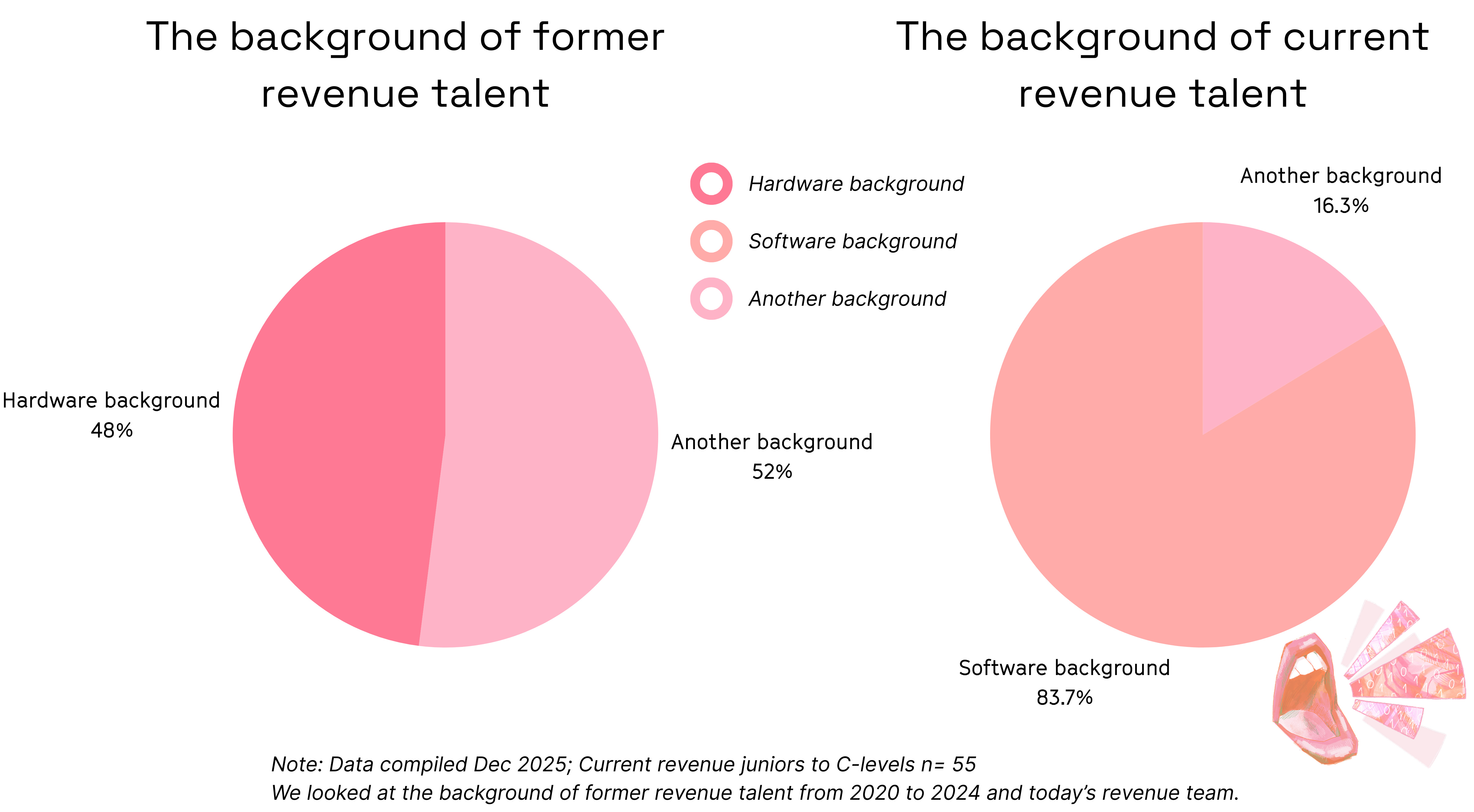
When we looked at their backgrounds, one thing immediately struck us: the contrast between current and former revenue talent. While 48% from 2020 to 2024 have had a hardware background, 83.7% of today’s team are software-native profiles.
Of course, RobCo positions itself as “centred on software and AI”, and RaaS models often require people who understand platforms, integrations, and data-driven outcomes.
Still, why such a shift?
When we spoke with Arjan van Staveren, CRO, he explained that the company initially focused on hiring revenue talent with hardware experience. But as the business evolved, RobCo made a deliberate shift toward software-first profiles to match its new commercial strategy.

The current structure of RobCo’s revenue team
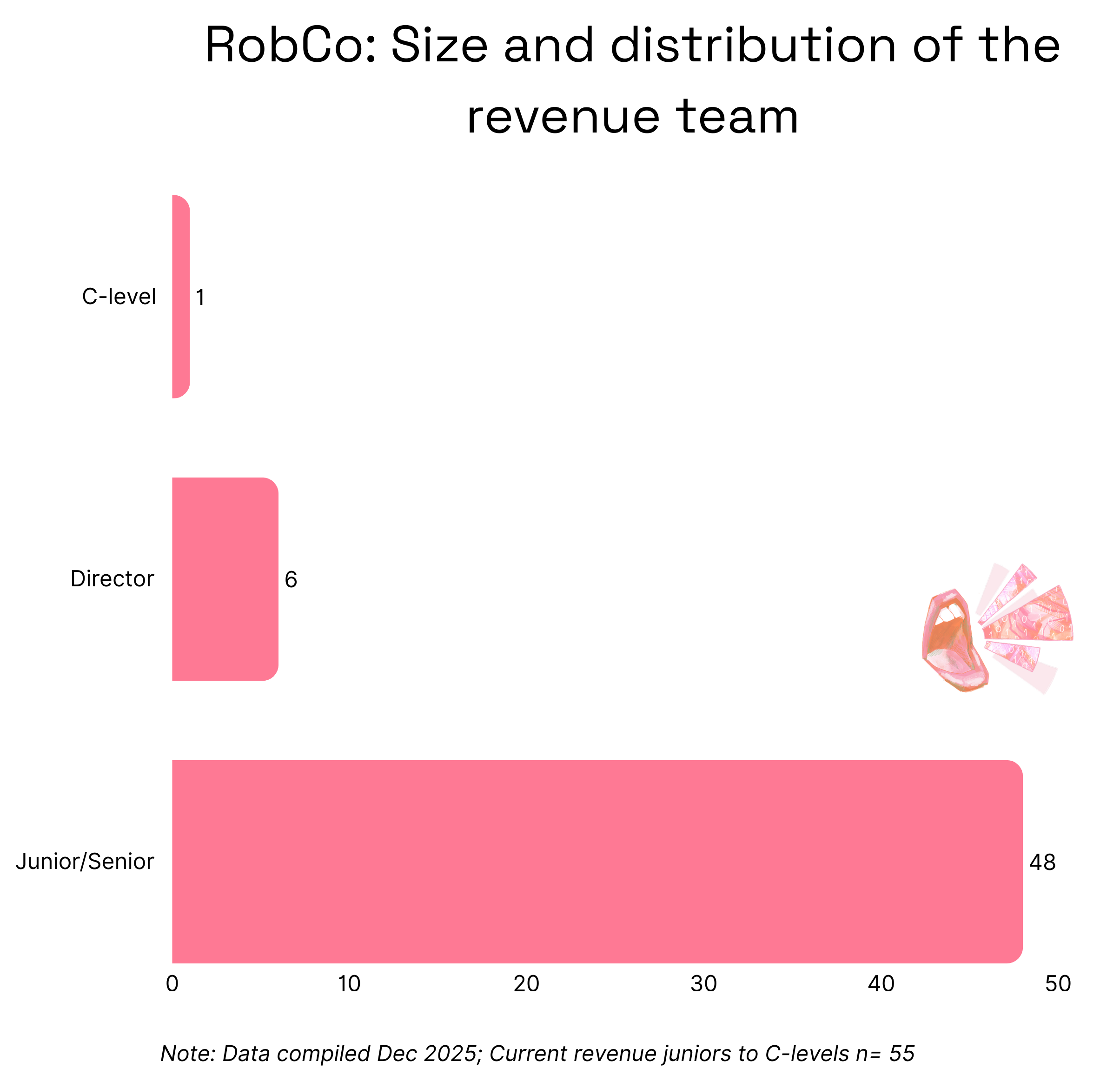
Most of them sit at the junior/senior level, with titles like Account Executive and Sales Development Representative. Their focus is on building and managing client relationships to generate and grow revenue.
In 2025, RobCo strengthened its revenue leadership with one key addition. The company hired Arjan van Staveren as CRO. Beneath him, six directors lead distinct areas within the function.
And just look at where this leadership talent comes from: Snowflake, Dataguard, Deel, and Zscaler. Some have even brought former colleagues along. It’s an unusual move, especially in DeepTech, where companies typically prioritise hiring people who are trusted within their target industries. RobCo took a different path and intentionally recruited top SaaS talent, even though they tend to be hard to move and often expensive.
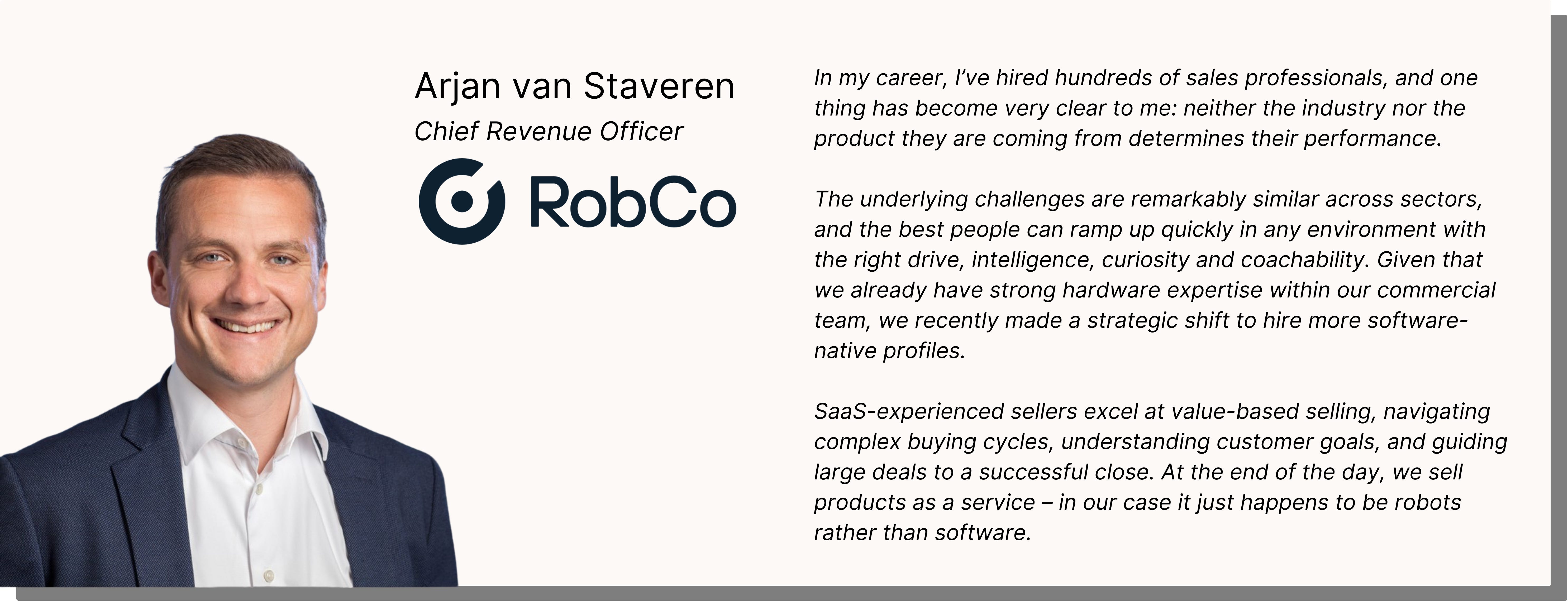
The truth is, great salespeople don’t necessarily need to come from the same industry to succeed. With the right structure and onboarding, professionals who’ve never sold robotics can thrive if they know how to build long-term partnerships, sell to enterprise clients, and navigate complex deals.
Building revenue muscle in Europe’s Novel Robotics industry
So far, Europe has only produced one Novel Robotics unicorn, Agile Robots, which makes it challenging for other emerging players to find talent that has already navigated the scale-up phase.
To address this, RobCo has shifted its hiring strategy from hardware-focused to software-native profiles. While it’s still too early to evaluate the full business impact, it’s a bold and unconventional move to bring in SaaS-trained talent to lead a DeepTech commercial strategy.
And it’s definitely one to keep an eye on.
It will be interesting to see over the coming months and years how RobCo performs and continues to navigate its growth journey as it blends hardware roots with a more SaaS-minded commercial strategy.
Scaling robotics requires more software than hardware.