

Comparing two FinTechs: Klarna vs Adyen's Sales & Marketing teams
We pulled some benchmarks of how two top tech companies perform in revenue efficiency.
Klarna has made headlines as it prepares for a public listing on the New York Stock Exchange, following its recent partnership with Walmart’s OnePay—which makes Klarna the exclusive provider of installment loans for the payment app. And it continues to make noise about its AI-driven efficiency gains.
Meanwhile, Adyen, a public FinTech giant that went public in 2018, continues to stand out for its enterprise-level payment processing solutions and sustainable revenue growth.
Given both companies’ roughly similar FTE size and robust revenues, we compared their Sales & Marketing (GTM) teams, analyzing how each structures its go-to-market strategy. The goal is to pull some benchmarks of how two top tech companies perform in revenue efficiency - and to discover whether Klarna's AI gains are notable on the GTM side of the business as well.
Note: While Klarna and Adyen are often categorized under “FinTech,” each business model covers different market segments (B2C BNPL for Klarna vs. enterprise/merchant payment processing for Adyen). We reference SaaS benchmarks for illustrative purposes; keep in mind these differences when interpreting the data below.
Klarna vs. Adyen Headcount & ARR Growth

Sources: Dealroom & Companies' annual reports
We analyzed employee & ARR growth at both companies from 2020:
Adyen (2020-2024): 25.58% annual FTE growth rate & 30% annual ARR growth rate
Klarna (2020-2022): 30.65% annual FTE growth rate & 31.5% annual ARR growth rate
Klarna (2022-2024): -21.31% annual FTE growth rate & 23% annual ARR growth rate
This decline in Klarna's workforce aligns with its AI-driven cost-cutting and operational efficiency strategy. In 2023, the company froze hiring to accelerate AI adoption. At the heart of this shift is its CEO’s belief that AI can already perform most human jobs. Consequently, Klarna plans to close three office locations: Amsterdam and Mannheim by the end of 2025 and Columbus by March 2027.

Overall Size & Distribution of Sales & Marketing Functions in 2024
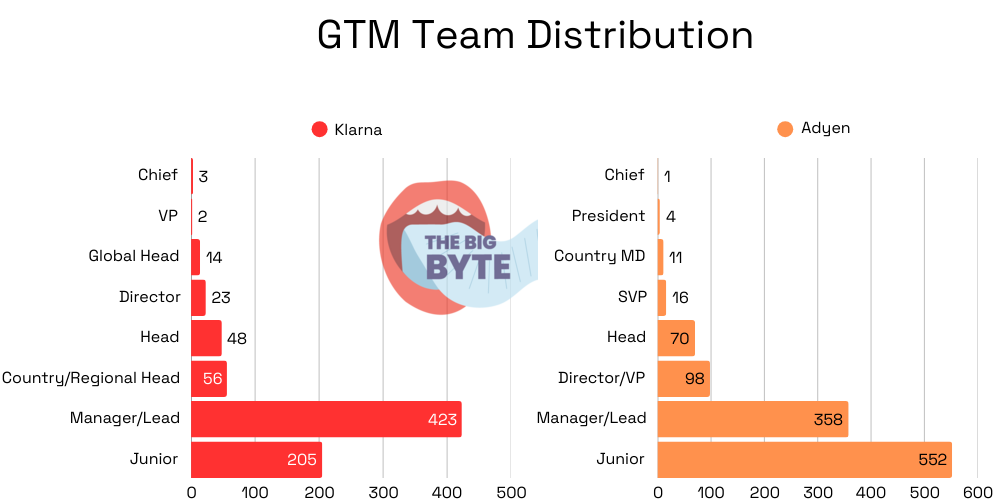
GTM size: 774 FTEs for Klarna vs. 1110 FTEs for Adyen
GTM team distribution: Spread across eight organizational layers, from executive to junior positions.
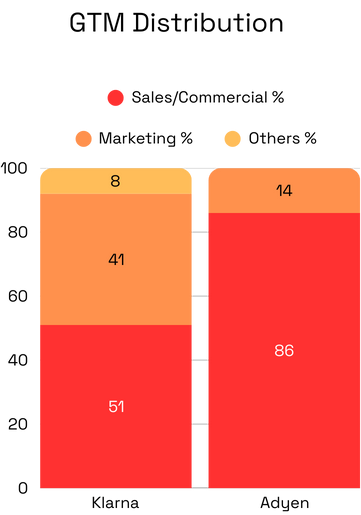
GTM team as a percentage of total headcount: 22.6% of Klarna's total headcount and 25.5% of Adyen's total headcount.
These numbers echo previous findings that GTM teams should make up approximately 25% of the total headcount in SaaS companies with an ARR exceeding $50 million.
Deeper Breakdown:
Sales/Commercial:
Klarna: 11.5% of total headcount
Adyen: 22% of total headcount
Marketing:
Klarna: 9.4% of total headcount
Adyen: 3.5% of total headcount
Other GTM Functions (e.g., Expansion):
Klarna: 1.7% of total headcount
Klarna’s higher proportion of marketing staff reflects its B2C and brand-building emphasis, while Adyen’s heavier investment in sales correlates with its sales-led, enterprise-focused strategy.
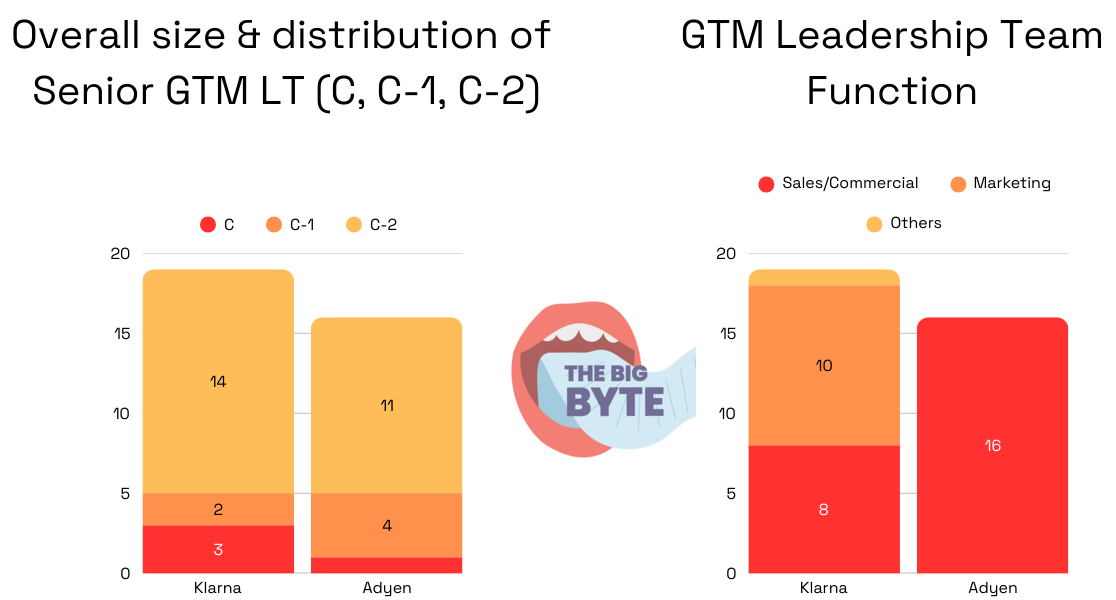
Leadership GTM Size & Distribution
Adyen’s Sales-Led Growth Focus
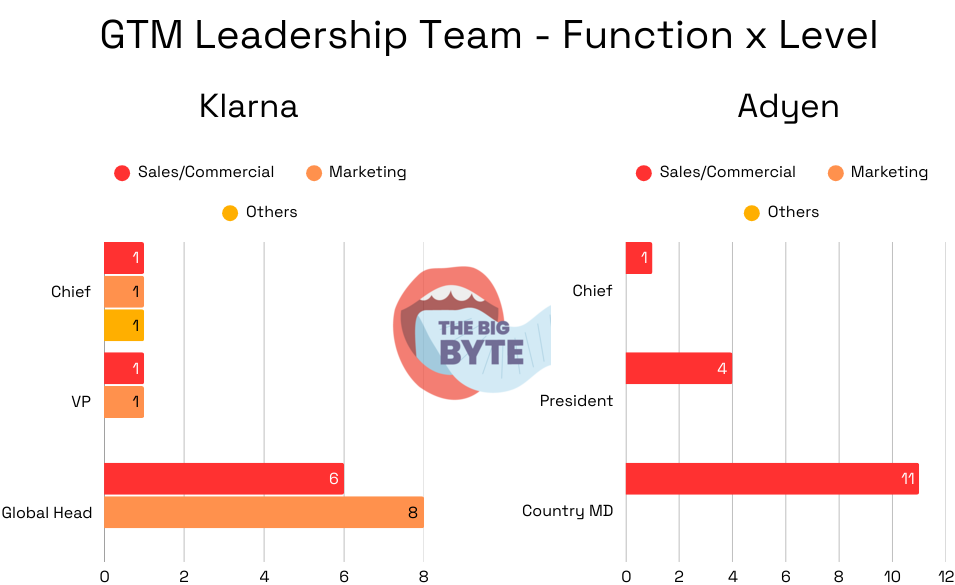
Adyen’s organizational hierarchy highlights four Regional Presidents and an SVP of Global Management & Partnerships, with Country Managing Directors (MDs) reporting to these Presidents. Notably, there is no dedicated C-level marketing executive; the highest-ranking marketing leader is at the C-3 level. This makes sense given:
Enterprise and Mid-Market Orientation:
Adyen’s clients often require custom integrations; thus, direct sales relationships are crucial for understanding client requirements and building tailored solutions.
Distributed Marketing Responsibilities:
Marketing tasks are shared among growth, partnerships, and country management. This is reminiscent of other companies (e.g., Uber, Lyft), which integrate marketing functions under broader mandates like operations or revenue leadership.
Klarna’s Dual BNPL + B2C Branding Approach
Klarna began with a sales-led BNPL model, educating businesses on its solution. However, from 2021 onwards, Klarna pivoted more heavily to B2C marketing, investing in brand awareness campaigns to win over end consumers. This shift is reflected in its leadership structure:
One Chief, One VP, and Six Global Heads leading partnerships and partner success
A Chief Marketing Officer (CMO) overseeing multiple global marketing heads
Revenue Efficiency
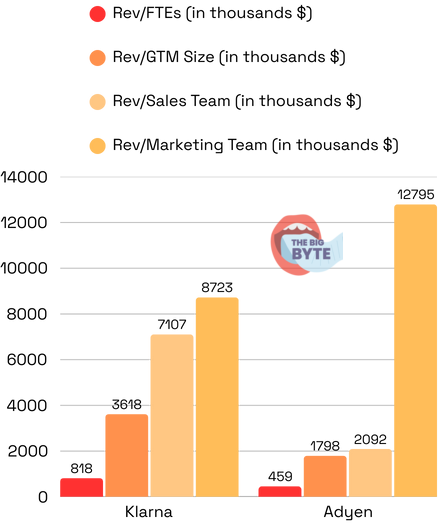
Revenue/FTE:
$818k Klarna
$459k Adyen
Average Revenue/GTM Size:
$3.6m Klarna
$1.8m Adyen
Average Revenue/Sales Team:
$7.1m Klarna
$2m Adyen
Average Revenue/Marketing Team:
$8.7m Klarna
$12.8m Adyen
Public SaaS companies have a median of $283k ARR per FTE, with top-quartile performers reaching $369k ARR per FTE. While Klarna and Adyen outpace companies like Stripe ($308k Revenue/FTE), they still fall short of FinTech leaders like Affirm or PayPal (respectively $912k and $989k Revenue/FTE).
Leadership-Level Revenue Insights
Klarna’s Revenue per GTM Leadership (C-Level, C-1, C-2): $147 million
Adyen’s Revenue per GTM Leadership (C-Level, C-1, C-2): $124 million
This comparison points to slightly higher efficiency at Klarna’s top GTM tiers. However, the broader context is that Klarna’s leadership team has a strong marketing emphasis, while Adyen’s leadership team is oriented toward enterprise sales.
Conclusion
Klarna’s negative FTE growth (-21.31% from 2022 to 2024) contrasts with its 23% ARR growth rate, boosting its revenue-per-FTE metrics to $818k (compared to Adyen’s $459k). Across GTM roles, Klarna generates $3.6 million per head, roughly double Adyen’s $1.8 million, most notably in sales ($7.1 million vs. $2 million). However, Klarna’s marketing efficiency ($8.7 million) still trails Adyen’s $12.8 million. The key question is whether AI-driven efficiencies can sustain these gains without undermining brand or customer acquisition—particularly in Klarna’s consumer-facing BNPL segment—while Adyen’s stable, enterprise-focused model continues to rely on direct sales to drive growth.